|
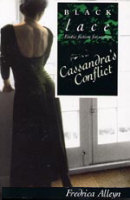
1993

|
|
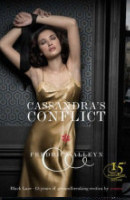
2008

|
|
I can't
believe that 15 years have passed since I wrote 'Cassandra's
Conflict'. It was very exciting for me to be invited to
write one of the four launch titles, but also slightly nerve
wracking. No one involved in the launch of Black Lace had
any idea of how the books would be received, as the concept
of 'erotic fiction, written for women by women' was an entirely
new one. The erotic fiction market had always been written
with men as the target reader, even though a considerable
number of women did read them.
I researched my book by inviting groups of female friends
round, plying them with wine and then asking them about
their secret sexual fantasies. The results were very interesting,
and one common theme cropped up again and again. This was
the idea of a man coming into their life who would make
them, initially against their will, explore their own sexuality
in ways they would never have been willing to suggest themselves.
This theme seemed to me to be an erotic version of 'Jane
Eyre', and possibly explains that novel's enduring appeal
to women!
Working on the assumption that this would probably be a
one-off book, I made sure that I included everything possible
in it, catering for all tastes but with a main theme of
bondage and domination. This resulted in one reviewer noting
that it was the first book she had ever read where she'd
had to flick through it to find the 'clean' parts!
When
the first four books were published, there was an incredible
reaction. The Sunday Times book cartoon depicted all four
of the launch titles stacked in piles on tables in a bookshop.
Queues of men were grabbing the books, all saying 'it's
for my wife'. At the till one shop assistant was saying
to another 'I don't know who's buying these books' and the
second one was replying 'liars mostly.' This, although funny,
was in fact totally untrue. Thousands of women were buying
them, and filling in the questionnaires at the back to give
the authors feedback.
I didn't
get, or indeed expect, any good reviews from the media,
who were fairly united in their condemnation of the concept.
I remember that Claire Rayner, having read my book in order
to review it, said that she knew I wasn't really a woman
as only a man could have written something so disgusting.
The
Australian Daily Telegraph Mirror, in its 'Life' section,
in an article entitled 'Mills & Bondage' reviewed Cassandra,
and the end of the review stated:
'Readers
with a shred of cynicism will find it hard to accept these
characters who have devoted their lives to pleasures of
the flesh. Cassandra, despite initial reservations, loves
every minute of her erotic education. She vaguely resembles
a traditional heroine in that she rides off into the sunset,
but it's only to another orgy'.
The
article went on to state: 'Asked what her husband thinks
of her foray into erotic fiction, Alleyn gives a coy giggle.
'He's vastly amused by it all,' she said. 'He helped me
considerably in writing the novel, but not in the way
you might imagine. He would read what I wrote each day,
in case I'd written about something which was physically
impossible for a man to achieve.'
Alleyn rejects claims that Black Lace novels are pornography,
and applauds the notion that erotica for women has gone
mainstream. 'I suppose the prominence of erotica for women
is another reflection of the way our horizons have been
broadened over the past forty years. In these novels the
heroine is always in control and always comes out on top.'
On 16th
September 1994, with a large picture of my book jacket at
the top of the page, novelist Candida Crewe wrote a full
page article in the Daily Mail entitled 'Why do women writers
betray their own sex?' In it she accused women writers of
erotic fiction of feeding the myth that the feminine sex
is turned on by reading about submissive women being degraded
by men. She said 'This is the stuff of male fantasy, and
seriously nasty male fantast at that. At least if women
must compete with men at this dubious game they have the
imagination to come up with something original.'
In fact,
as Black Lace celebrated its first birthday, the Sunday
Times quoted how 'a recent readership survey had provided
interesting reading, with shop assistant, nurses, and advertising
executives queuing to hail the "sense of liberation
in having pornography for me in WH Smith" When
asked to select characteristics for their ideal hero, survey
respondents put "sexually dominant" first,
with a 70% score, ahead of "caring", "romantic"
or "hunky". Their list of ideal erotic
themes is correspondingly headed by "submissive
female", ahead of "romantic love",
"dominant female" and various kinky options.
Back to basics, really.'
I was
so incensed by Candida Crewe's article, that I wrote to
the Daily Mail, as Fredrica Alleyn, and this letter was
published by them on 21st September 1994.
'As
author of Cassandra's Conflict, I can tell you that Black
Lace novels aren't text books, or serious literary works.
They're escapist sexual fantasies for women, greatly enjoyed
by thousands of women who understand this. Black Lace
questionnaires and my own discussions with women show
most women's favourite sexual fantasy involves submissive
women and dominant men, although they feel guilty about
this because of the current "politically correct"
climate. I am sorry if this doesn't fit Ms Crewe's idea
of what women should fantasise about, but women's liberation
is intended to give them the freedom to enjoy their sexuality
in any way they choose. Why should they get over being
dictated to by men only to be dictated to by politically-correct
feminists? These books are not a betrayal. A lot of women
enjoy reading them, and are grateful that at least they
can buy them freely in general bookshops. If you don't
like them, don't buy them. There are plenty of other women
who will.'
Fifteen
years on, with Black Lace still going strong, I do feel
that I've been proved right. I'm delighted that I was there
at the beginning and equally delighted that my first Black
Lace novel is being reissued as part of their anniversary
celebration.
Margaret
Bingley,
December, 2007 |
|